






Occupational safety
Material Issue Occupational safety
Targets/Vision
- ●No industrial accidents (including minor injuries)
Management and Promotion Method of Occupational safety
[Responsible Departments] Safety
- Manufacturing Planning Center
- Business facilities
Coordinating office: Company-Wide Health and Safety Committee (Secretariat: Safety and Quality Control Department of Manufacturing Planning Center)
[Policy/Point of view]
Recognizing that it is our responsibility to create a safe and comfortable workplace, the Group established the “Group Code of Conduct” and “Health and Safety Policy” to set health and safety targets and is striving to create a safe and comfortable workplace with the cooperation of our employees.
[Targets/Vision]
- No industrial accidents (including minor injuries)
[Measures]
To achieve objectives set out in the “Safety and Health Basic Policy,” we set safety goals and undertake improvement activities at all times with the Health and Safety Committees at headquarters and each office monitoring the progress of health and safety activities on a regular basis.
- 1. Establish basic actions
- 2. Promote safety measures based on risk assessment
- 3. Enhance health and safety education to prevent accidents from occurring
- 4. Promote various activities such as health and safety patrols
Occupational Safety and health management system certification
All of the Company’s plants have acquired occupational safety and health management system (JISHA-method OSHMS) certification. Among the eight overseas affiliates with production bases, five (62.5%) have acquired occupational safety and health management system certification (ISO45001).
- OSHMS Certification
Ashikaga Plant, Wakayama Plant, Nankai Plant, Kakogawa Plant - ISO45001 Certification
Bando Manufacturing (Thailand) Ltd.
Bando Belt Manufacturing (Turkey), Inc.
Bando (India) Pvt. Ltd.
Bando Korea Co., Ltd.
Bando Belt (Tianjin) Co., Ltd.
Safety and Health Initiatives
The Group’s safety and health activities mainly focus on risk assessments and risk forecast activities.
In fiscal 2024, Nankai Plant achieved a record of 12.5 million hours of accident-free operation (no accident resulting in accidental death or absence from work for not less than one day) and received the “No Industrial Accident Record Certificate (Class 4)” from the Minister of Health, Labour and Welfare.
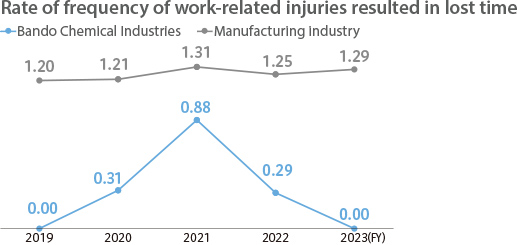
Key initiatives for fisical year 2025
-
Promotion of risk assessments and safety measure for equipment
During the CV-1 period, we conduct comprehensive inspections to identify and eliminate overlooked risks. In fiscal 2025, we rolled out lockout procedures for maintenance work across the Group. Furthermore, we promoted risk assessments that identify risks based on the relationship between hazards and work activities, and systematically implemented improvements for high-risk items identified.
-
Ensuring the proper use of personal protective equipment
To make personal protective equipment (PPE) requirements more visible at work sites, we post illustrations showing the required PPE and the roles of those responsible for managing its use at production sites, thereby promoting the proper use of PPE.
-
Thorough compliance with safety rules
In addition to safety and health patrols conducted at each office and group company, the President sends a message about safety to all employees every year in time for the National Safety Week in every July and “Bando Safety Day” on October 7.
We conduct Head Office safety and health patrols jointly with the labor union in May and led by the President and Corporate Executive in charge of safety and health in October. We also hold workplace discussions on “why rules are not followed and how we can ensure that everyone follows them,” and provide Safety and Health Control Manager with feedback based on an analysis of the discussions as part of our ongoing improvement efforts. -
Safety sensitivity improvement training using disaster simulation equipment
We provide a training to enhance employees’ sensitivity to risks inherent to their works through a simulation of potential accidents, such as “being caught or stuck in machines,” that are likely to occur at the Group’s production facilities. We expanded the scope of the training to the entire Group since fiscal 2014 and installed the disaster simulation equipment in all of domestic plants and affiliates as well as in 9 major overseas production bases to promote similar training.
-
Strengthening chemical substance management
To ensure a proper understanding of the roles of personnel responsible for chemical substance management and prevent employees from developing health issues attributable to the work environment, all of our plants receive guidance from occupational health consultants to improve the work environment and enhance knowledge of chemical handling.
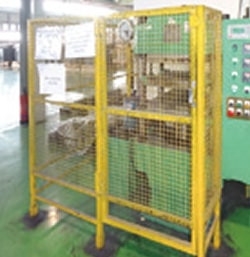 Press vulcanization equipment with a safety fence
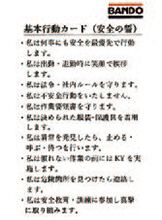
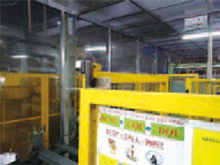 Thorough implementation of “stop, call, and wait”
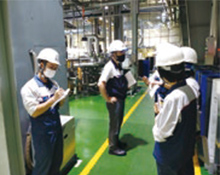 Bando Safe Day
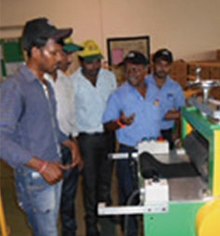 Safety sensitivity improvement training