



Product/process innovations
Material issue Product/process innovations
- Targets/Vision
- ●The ratio of Environmentally-Friendly Products and Products with Fewer Hazardous Substances among the total newly marketed products: 50% or more (fiscal 2026)
- ●Labor productivity: Double, Energy productivity: Double, Environmental impact productivity: Double
Management and Promotion Method of Product/process innovations
[Responsible Departments](Product)
- Engineering divisions
- Engineering Department of New Businesses Promotion Center
- Research laboratories
Coordinating office: Technical Committee (Secretariat: Technology Planning Group of Research Laboratories for Core Technologies)
[Policy/Point of view]
The “Group Code of Conduct” stipulates the preservation of the global environment, and the “Environmental Basic Policy” aims at saving resources and energy and reducing wastes and hazardous substances in each of the stages of technology development, design, procurement, production, sale, and use of products and services. In addition, we are working to develop high-functional, energy-saving, and low-environmental impact products meeting market needs.
[Targets/Vision]
Ratio of environmentally-friendly products among the total newly marketed products: 50% or more (fiscal 2026)
[Measures]
Products to be developed are checked against the “Environmental Instruction and Design Standards” at the time of proposal, registered as environmentally-friendly products for a development theme by the Technical Committee and monitored for its progress. When the development is completed, the products are reviewed by the Eco-moving Subcommittee of the Technical Committee and registered as environmentally-friendly products to appeal to customers and society.
[Responsible Departments] (Process)
- Manufacturing Technology Development of Manufacturing Planning Center
- Manufacturing technology divisions of business divisions
[Policy/Point of view]
The Group develops the manufacturing methods that care for the global environment and people in the mid-term management plan CV-1 as the innovation of manufacturing is essential to grow our core businesses globally and improve profitability.
Guideline 2: Creation of smart manufacturing, Development of smart manufacturing methods
[Targets/Vision]
Labor productivity: Double
Energy productivity: Double
Environmental impact productivity: Double
[Measures]
- Prepare for the Bando Dream Factory through the mid-term management plan CV-1
Manufacturing Technologies Development Department, Manufacturing Planning Center: Develop elemental technologies and manufacturing methods to improve labor and energy productivity
Manufacturing technology department of business divisions: Develop smart manufacturing methods for specific products
Product Innovation: Expand “Environmentally-Friendly Products”
We have focused on developing belt products for automotive and other industries for years and refined our energy-saving related technologies by sincerely addressing needs of customers and society. Currently, products under our eco-friendly private brand “eco moving,” products satisfying at least 50% of the baseline values for the Environmental Claims that define this brand, and products with fewer hazardous substances are grouped into the “Environmentally-Friendly Products” category, and we are working to expand it. By fiscal 2026, the final year of CV-1, we aim to increase the ratio of “Environmentally-Friendly Products” to 50% or more of newly marketed products.
In fiscal 2025, we newly certified 12 products as environmentally-friendly products, and “Environmentally-Friendly Products” accounted for 63% of the newly marketed products.

Labeling standards of “eco moving” products
The products are labelled as “eco moving” if any of the following three items are satisfied:
1. The product reduces CO2 emissions during its lifecycle compared to the pre-established reference product and meets at least one of the certification criteria specified in the Environmental Claims.
2. The use of the certification mark is permitted by a third-party organization that operates the environment-related accreditation system.
3. In case of new products for which the reference product cannot be established, the product meets the certification criteria clearly determined for the Environmental Claims at the planning stage of the product development by using industry standards as baseline value or setting our own baseline value.
[Other Environmentally-Friendly Products]

Environmental consideration at the time of disposal Transmission belts using non-chlorinated synthetic rubber.

1.Saving energy

The product’s energy loss during use is cut by 15% or more, in comparison with the corresponding reference product.
2.Saving resources

The raw materials used for the product are reduced by 10% or more by mass, in comparison with the corresponding reference product.
3. Reduction in quantity of waste

Product-related waste during use is reduced by 10% or more by mass, in comparison with the corresponding reference product.
4. Using recycled materials

The product uses 20% or more recycled materials by weight.
5. Using eco materials

The product uses 80% or more eco materials by weight (recycled materials as well as non-petrochemical natural resources and materials).
6. Reduction of CO2 emissions

The product reduces CO2 emissions by 10% or more during its lifecycle, in comparison with the corresponding reference product. Or, the product reduces CO2 emissions by 15% or more during any stage of its lifecycle (material procurement, production, transportation, use, disposal).
7. Carbon offset

The product is certified by the carbon offset certification system (third party institution), and the appropriate carbon offset activities have been implemented.
CO2 reduction contribution
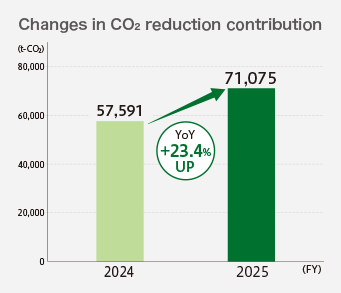
Since fiscal 2024, the Group has been calculating the CO2 reduction contribution by its eco moving products (environmentally-friendly products) to quantitatively assess their contribution to reducing environmental impact across society and to customers’ decarbonization.
In fiscal 2025, the CO2 reduction contribution by our eco moving products amounted to 71,075t-CO2, equivalent to approximately 87% of CO2 emissions from the Group’s production activities (Scope 1 and Scope 2).
For the calculation, we developed the “CO2 Reduction Contribution Guidelines” under the supervision of third-party experts, based on the GX League’s “Basic Guidelines for Disclosure and Evaluation of Climate-related Opportunities” and the WBCSD’s “Guidance on Avoided Emissions (released in 2023),” to ensure the appropriateness of the calculation methods and figures. We calculate our CO2 reduction contribution in accordance with these guidelines.
The Group will continue to contribute to the realization of a decarbonized society through its products.

Product Development That Contributes to Solving Customer Issues
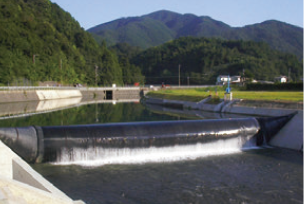
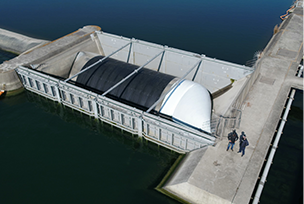
Food conveyor belt “Mr. L Keeper™”
Food conveyor belts may experience problems such as rippling and dimensional changes due to oil or powder from the food products being conveyed getting into the back of the belt during use or hot water washing for heat sterilization. These problems can cause belt meandering, or removing the belt from the conveyor for hot water cleaning can cause it to shrink, resulting in troubles where it cannot be reinstalled. As a result, belts need to be replaced frequently, lowing productivity. To solve all these problems, we have improved the canvas on the back of the belt to suppress dimensional changes of the belt compared to conventional products and have developed “Mr. L Keeper™,” a food conveyor belt with excellent low shrinkage properties, which was launched in April 2023.
In addition to suppressing dimensional changes due to oil and powder getting inside as mentioned above, the product also possesses antibacterial, mildew-proof and fray-free properties, as well as excellent moist heat and chemical resistance, allowing hot water cleaning at temperatures of up to 100°C.
We will continue to develop products that are people- and eco-friendly and solve social issues.

“Thermal Management” products contributing to downsizing/high efficiency/ high performance of electronic devices
In recent years, demand for "downsizing,” “high efficiency,” and “high performance” of electronic devices has been increasing at an accelerated pace in various fields due to the full-scale application of IoT and edge computing to the telecommunications industry in addition to the spread of the next-generation semiconductors in power devices used in automobiles, railways, and new energies, etc. To meet these demands, efficient “thermal management” that actively “controls heat” is indispensable, and it also requires an elaborate thermal design as well as high-performance electronic materials to realize it.
The Company has applied our core technologies, including the rubber and elastomer processing technologies developed from “dispersion technology,” to develop products that suppress heat generation by enhancing heat dissipation effects with a combination of orientation technology and nanoparticle generation technology and has produced optimal electronic materials for thermal management. We have developed and manufactured “distinctive products” that can solve customers’ issues in manufacturing electronic devices, including “HEATEX™,” a high thermal conductive sheet that has achieved ultra-high thermal conductivity using boron nitride as thermally conductive filler, and "FlowMetal™,” a silver nanoparticle bonding material paste which can be bonded at low temperatures and without pressurization.
Process Innovation: Advance initiatives to realize the “Bando Dream Factory”
Under Guideline 2 “Creation of smart manufacturing” in the Mid-Term Management Plan CV-1, as a step toward realizing the “Bando Dream Factory,” we are promoting the development of smart manufacturing methods that leverage digital technologies such as AI and IoT and reduce reliance on human skills. In fiscal 2025, we promoted the development of elemental technologies toward achieving unmanned and autonomous operations on the model lines for the “Bando Dream Factory” selected in fiscal 2024. On the model line at Wakayama Plant, we have developed and introduced AI and robotics to reduce certain manpower requirements in certain processes, significantly improving productivity while also addressing labor shortages. In fiscal 2026, we will continue to promote the development of elemental technologies with the aim of achieving unmanned operations on the line.
At the same time, we are also focusing on fostering digital talent to lead the development of smart manufacturing methods. We foster such talent through in-house education and external training programs on DX and the use of AI, while encouraging employees to obtain relevant qualifications such as the “IT Passport Exam” and “Deep Learning for GENERAL (G-Test).”
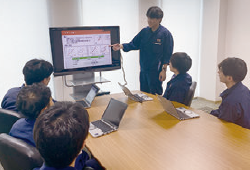
“AI Workshop” for digital talent development
Development of visual inspection device using AI
The Bando Group has been promoting the application of AI to manufacturing sites to raise the level of SEQDC (Safety/Environment/Quality/Delivery/Cost) of our products. In fiscal 2019, we started the application of AI to part of the visual inspection. We will continue the development to overcome issues in the visual inspection including “it takes time to foster inspection workers,” “inspection results varies depending on inspection workers,” and “inspection takes manhours” while aiming at flexible response to changes in production volume. We will also broaden the scope of AI application to various manufacturing sites in addition to the visual inspection device.
Improve precision and efficiency of the compounding design using material design simulation by quantum chemical calculations
We use the quantum chemical calculations to model material structures on the molecular level and clarify how physical properties appear through simulations.
Compared to the conventional methods that evaluate physical properties by test productions or experiments based on past knowledge and experiences, this new material design method can not only increase development speed but also further improve performance through a theoretical approach such as comparing and verifying simulation and experiment results.
* We use a supercomputer of Foundation for Computational Science (“FOCUS”) for the quantum chemical calculations.
Optimized structure

Comparison of IR spectrum

Experiment results

Simulation results
TOPICSChallenge to new production method of accessory drive power
transmission belts for automobiles
Under the new production method, characteristics of materials have a greater impact on product features (results) than the conventional method. Although we had difficulty setting conditions for stable processing, young development team members combined their expertise and repeated tests, achieving the reduction of material loss by more than 60% and the improvement of resource productivity. The newly developed and introduced heating method, for which we obtained a process patent, can reduce energy consumption by more than 50% compared to the conventional method and also contributes to the improvement of working environment. We were able to shorten the processing time by dividing processes in the line with the new production method and improve labor and capital productivity by introducing robots for transferring, attaching and detaching molds.

Contributing to reduction of industrial waste and energy consumption
The establishment of a new production method for urethane belts also enables to reduce industrial waste through reduction of urethane material loss and also reduce energy consumption resulting from shortened crosslinking time and a change of the heating method.
TOPICSPursue further potential of urethane
materials through
a new production method
In order to establish a new production method, we utilized urethane material
technology, one of our core technologies, and designed unique compounding of
urethane materials which will be the base. As the handling of the urethane materials
with new compounding was difficult, we fundamentally reviewed the manufacturing and
design conditions of the belt itself. After a number of trial and error, we finally
established manufacturing conditions and solved various technical issues, and
consequently, we successfully developed a production method enabling to improve
labor and capital productivity and reduce material loss.
The belts made of urethane materials with new compounding exhibit the durability
three times higher than that of conventional products and are also more
cost-efficient as they require a fewer number of molds to manufacture. We will
continue to work on “Enhancement and Evolution in Manufacturing” mainly with our
main power transmission belt products and pursue further potential.